
Why API-First Beats Monolithic Platforms
📅 4 February 2026 | 📂 Online Travel Agencies, Travel Technology
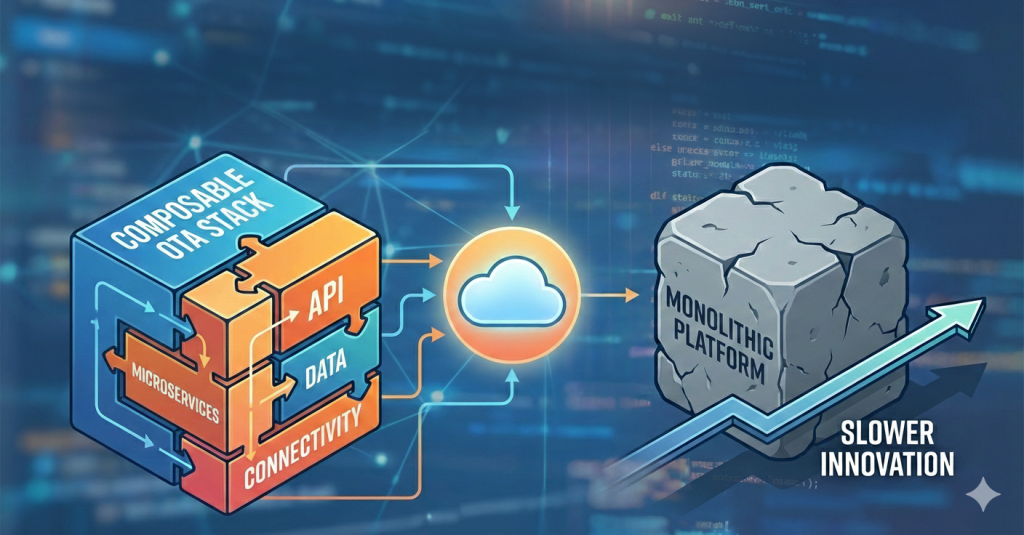
Your legacy booking platform processes millions of transactions annually, but it’s bleeding opportunity. Industry data reveals that 44% of spontaneous travel bookings remain unmonetized, while 71% of travelers now expect personalized recommendations that traditional systems simply cannot deliver. The experience economy has unlocked a $253.3 billion opportunity in ancillary services, yet most OTAs capture less than 15% of this revenue due to architectural limitations inherited from platforms built for a different era.
As Booking.com and Expedia accelerate their AI-driven personalization initiatives, the competitive gap widens daily. The culprit isn’t strategy or market positioning, it’s the monolithic architecture that made sense in 2010 but has become your greatest liability in 2026. The path forward isn’t incremental upgrades to aging systems; it’s a fundamental reimagining of your technology stack through composable, API-first architecture that treats agility as a core business requirement, not a technical aspiration.
Why Architecture Matters Now for CTOs
The travel technology landscape has reached an inflection point where architectural decisions directly determine competitive viability. CTOs at OTAs and DMCs face unprecedented pressure from multiple fronts: consumer expectations shaped by hyper-personalized experiences from adjacent industries, venture-backed competitors launching with cloud-native stacks unburdened by legacy constraints, and margin compression that demands revenue diversification beyond core accommodation booking.
Traditional monolithic platforms, initially designed for centralized control and feature completeness, now represent the primary bottleneck preventing innovation velocity. Booking.com’s recent pivot toward AI-powered itinerary planning and Expedia’s investment in predictive personalization engines signal a market shift where experience orchestration, not transaction processing, defines differentiation.
For OTAs still operating on tightly coupled systems, the cost of inaction compounds daily: new feature deployment cycles measured in quarters rather than weeks, inability to rapidly test and integrate emerging experience APIs, and mounting technical debt that consumes 60-70% of engineering capacity on maintenance rather than innovation. The architectural choices you make in 2026 will determine whether your platform can adapt to the AI-native, experience-first travel ecosystem emerging over the next three years.
The Hidden Cost of Architectural Rigidity
Monolithic OTA platforms suffer from three structural constraints that translate directly into revenue leakage and competitive disadvantage. First, deployment complexity means that adding a new ancillary offering, whether restaurant reservations, local experiences, or destination services, requires modifying, testing, and redeploying the entire application stack. This creates deployment cycles of 8-12 weeks for features that competitors launch in days, resulting in missed seasonal opportunities and delayed responses to market trends.
Airlines learned this lesson painfully; carriers like Lufthansa and AirAsia migrated to microservices specifically because monolithic booking engines couldn’t handle dynamic pricing adjustments or personalized upsells without complete system redeployments. The opportunity cost is measurable: each quarter of delay in launching experience monetization represents 3-5% of potential ancillary revenue left on the table.
Second, scalability inefficiency forces you to over-provision infrastructure to support peak demand across the entire platform rather than scaling individual components. When holiday travel drives booking volume 300% above baseline, your monolithic architecture requires scaling reservation processing, user authentication, content management, and payment systems simultaneously; even though only the booking engine faces load stress.
This architectural tax increases cloud infrastructure costs by 40-60% compared to composable alternatives where individual services scale independently based on actual demand. Worse, this inefficiency extends to your team structure: any modification to the checkout flow requires coordination across database, application, and front-end teams, slowing iteration velocity and creating organizational bottlenecks that mirror your technical constraints.
Third, integration fragility makes connecting to best-of-breed experience APIs prohibitively risky. Adding a destination activities marketplace or AI-powered itinerary service to a monolithic platform typically requires custom integration work that touches core booking logic, introduces regression risk, and creates vendor lock-in through tight coupling. CTOs report that 70% of new integration projects fail quality assurance on first deployment due to unforeseen dependencies within monolithic codebases.
This architectural brittleness explains why most OTAs offer identical commodity experiences, flights, hotels, car rentals, while emerging competitors monetize the experiential “white space” between these anchor bookings. The revenue implications are stark: travelers who book experiences through their OTA demonstrate 33% higher lifetime value and 51% better retention rates, yet monolithic architectures make experience integration a multi-quarter engineering project rather than an API configuration.
The API-First Alternative: Building for Composability
API-first architecture inverts the traditional development model by treating programmatic access as the primary interface rather than an afterthought. In this paradigm, every business capability, user authentication, inventory search, booking processing, payment handling, experience recommendations, exists as an independent service that exposes well-documented APIs for both internal and external consumption. This composable approach delivers three strategic advantages that directly address the constraints of monolithic systems.
Independent deployment velocity allows product teams to ship new features without coordinating across the entire engineering organization. When your destination experiences team wants to add a new supplier integration or personalization algorithm, they modify only the experiences service and deploy through automated CI/CD pipelines without touching booking logic, user profiles, or payment processing. Airlines that adopted this model, such as Lufthansa, reduced deployment time for new features by 40% while simultaneously decreasing downtime during peak traffic periods by 30% through fault isolation. For OTAs, this translates to weekly release cycles for experience offerings, enabling rapid testing of new content partnerships, pricing strategies, and personalization approaches that drive incremental revenue.
Elastic resource allocation matches infrastructure costs to actual business demand rather than peak theoretical load. During high-season booking surges, your API-first architecture auto-scales only the search and reservation services while maintaining baseline capacity for user profiles, content management, and ancillary offerings. This granular scalability reduces infrastructure costs by 35-45% compared to monolithic systems that require over-provisioning across all components. More importantly, it enables economically viable testing of new revenue streams: launching a pilot destination concierge service or AI-powered itinerary builder requires minimal infrastructure investment because these services scale independently based on adoption rather than forcing platform-wide capacity increases.
Ecosystem connectivity transforms your OTA from a closed platform into an orchestration layer that curates best-of-breed experiences. With API-first architecture, integrating a destination activities marketplace, restaurant booking engine, or local guide platform becomes a matter of API authentication and mapping rather than custom integration development. This composability enables the “Marketplace OTA” model where you monetize third-party experiences through commission or markup without managing inventory, supplier relationships, or fulfillment operations.
Tripian’s experience API exemplifies this approach: OTAs integrate 300,000+ experiences across 550 destinations through a single RESTful API that handles discovery, booking, and fulfillment, typically completing integration in 4-6 weeks versus the 6-9 months required for traditional monolithic integrations.
Evaluating Integration Partners vs. Build-Your-Own
The composable model introduces a strategic question absent in monolithic architecture: which capabilities should you build internally versus integrate through best-of-breed API partners? The evaluation framework centers on three criteria: strategic differentiation, core competency alignment, and speed-to-value.
Strategic differentiation asks whether a capability provides a unique competitive advantage specific to your market position. Core booking logic, proprietary pricing algorithms, and customer profile management typically warrant internal development because they embody your specific business model and competitive strategy.
Destination experiences, conversely, rarely provide differentiation through proprietary development—travelers don’t choose OTAs based on whether you built your activities marketplace internally versus integrating a comprehensive API like Tripian’s. The differentiation comes from content breadth (300,000+ experiences), destination coverage (550 cities), and conversion optimization, not architectural ownership.
Core competency alignment evaluates whether your engineering organization possesses the domain expertise and ongoing commitment required to maintain a capability at competitive standards. Building a destination experiences platform requires expertise in supplier relationship management, activity content curation, real-time inventory synchronization, and fulfillment operations across hundreds of destinations. Integration partners like Tripian, maintain this specialized expertise, continuously expanding content partnerships and optimizing conversion based on aggregated learnings across multiple OTA clients, insights your internal team would need years to develop independently.
Speed-to-value measures how quickly each approach delivers measurable business impact. Internal development of a destination experiences platform typically requires 18-24 months to achieve meaningful content coverage and conversion optimization, with ongoing engineering investment to maintain supplier relationships and content quality.
API integration through specialized partners delivers production-ready experiences marketplace in 4-6 weeks, generating incremental revenue (typically 33% increase) within the first quarter post-launch. For CTOs operating under board-level pressure to diversify revenue streams and combat margin compression, the speed differential often determines viability; waiting two years to launch experiences means ceding market opportunity to competitors who integrated API-first solutions immediately.
Taking Action: Your API-First Roadmap
The composable OTA stack isn’t a speculative future state, it’s the operational reality at leading travel companies that have already completed this transition and are capturing the competitive advantages. For CTOs at OTAs and DMCs still operating monolithic platforms, three imperatives emerge:
- Start with experiences monetization as your composable beachhead: Integrate an API-first destination activities marketplace to validate the model, generate immediate revenue lift, and build organizational confidence without touching core booking logic
- Establish API governance and data unification now, before deploying additional composable services: Invest in the foundational layer: API standards, security protocols, unified customer data that enables sustainable composability rather than creating integration fragmentation
- Measure business impact, not technical outputs: Frame your composable transformation around deployment velocity, revenue acceleration, and innovation capacity; metrics that resonate with board priorities and justify continued investment
Recommended Next Steps for CTOs
Tripian offers a comprehensive technical architecture review designed specifically for OTA and DMC technology leaders evaluating composable stack transitions. This engagement includes:
- OpenAPI specifications and integration architecture documentation showing exactly how Tripian’s experience API integrates with your existing booking flow, user authentication, and payment processing
- Sandbox access with pre-production API credentials enabling your engineering team to prototype integration, evaluate API ergonomics, and assess effort required for production deployment
- Reference architecture review with CTOs from similar OTAs who have completed composable transitions, providing peer insights into migration sequencing, organizational change management, and ROI realization timelines
- The shift from monolithic to composable architecture represents the most consequential technology decision OTA CTOs will make in 2026. Those who move decisively will capture the $253 billion experience economy opportunity while building the agile, AI-ready infrastructure required for the next decade of travel innovation. Those who delay will find themselves trapped in increasingly expensive maintenance of aging platforms, watching competitors monetize the travel experience while they process commodity transactions at eroding margins
Contact Tripian Labs to request your technical architecture review, sandbox credentials, and OpenAPI specification package.

Your Trip Planner Is Lying. Here’s Why.
A credible study just handed your AI roadmap a liability. In testing published by Forbes and InsureMyTrip, AI-powered travel planning tools recommended restaurants, attractions, and experiences that simply do not exist. Not outdated listings. Not temporary closures. Fabrications, complete with…

You Win the Booking. You Lose the Journey.
Forty-four percent of in-destination activities are booked outside the platform that originated the trip. Not because travelers are disloyal. Because the platform gave them no reason to stay. The Funnel You Built Isn’t Broken — It’s Just Incomplete The OTA…

The Platform Era in Travel:
Why Connectivity Determines Competitive Advantage
Enterprise OTAs and DMCs are losing between $8-15M annually to a problem hiding in plain sight: 44% of spontaneous in-destination bookings happen outside their platforms. While your systems capture the initial flight and hotel reservation, travelers are booking experiences through…