
Why Connectivity Determines Competitive Advantage
📅 18 February 2026 | 📂 Travel Tech Insights
Enterprise OTAs and DMCs are losing between $8-15M annually to a problem hiding in plain sight: 44% of spontaneous in-destination bookings happen outside their platforms. While your systems capture the initial flight and hotel reservation, travelers are booking experiences through competitor platforms at the destination; revenue that should be yours. With the online travel booking market projected to reach $3.0 trillion by 2030 and 71% of travelers expecting personalized experiences, the gap between customer expectations and platform capabilities has never been more critical.
The Connectivity Crisis Reshaping Competition
Your legacy booking engine wasn’t designed for today’s connected travel economy. While Booking.com and Expedia deploy AI-powered trip planners that consider “1.26 quadrillion variables” to deliver personalized recommendations, traditional platforms struggle with fragmented systems that consume 40% of engineering capacity on technical debt maintenance rather than innovation. The competitive threat isn’t just feature parity: it’s architectural. Modern travel platforms operate as connected ecosystems where real-time personalization, dynamic inventory access, and seamless booking flows determine market position.
The challenge centers on three technical barriers: legacy monolithic architectures that can’t support AI-driven personalization at scale, the absence of unified platforms connecting recommendations to bookable experiences, and insufficient infrastructure to capture and activate first-party customer data while maintaining GDPR compliance.
The API-First Architecture Imperative
CTOs at leading travel companies are abandoning 18-24 month platform rebuilds in favor of composable, API-first architectures that integrate AI personalization as standalone microservices. This approach delivers enterprise-grade capabilities—sub-200ms API response times, 99.9% uptime serving millions of concurrent users, and serverless AWS infrastructure that auto-scales without manual provisioning—in 4-6 weeks rather than requiring wholesale platform replacement.
The economics are compelling: organizations deploying connected personalization infrastructure through strategic API partnerships achieve 33% increases in per-guest activities revenue, 51% redemption rates on personalized offers versus 5-8% industry baselines, and reallocate 15-20 engineers from legacy maintenance to revenue-generating innovation. More critically, they compress competitive response time from quarters to weeks, maintaining feature parity as AI-driven personalization becomes table stakes.
Acting on the Platform Imperative
For CTOs evaluating connectivity investments, three criteria determine success: proven 4-6 week integration timelines with API-first architecture that augments rather than replaces existing infrastructure, enterprise-grade security with SOC 2 Type II certification and zero PII collection, and white-label flexibility maintaining complete brand control. The strategic question isn’t whether to modernize connectivity infrastructure—it’s whether to commit 18 months and $2-5M building internally or deploy proven enterprise solutions in weeks.
Ready to evaluate your connectivity architecture? Request technical specifications, sandbox access, or schedule an architecture review to assess integration pathways for your platform.
The Channel Manager’s Next P&L Line
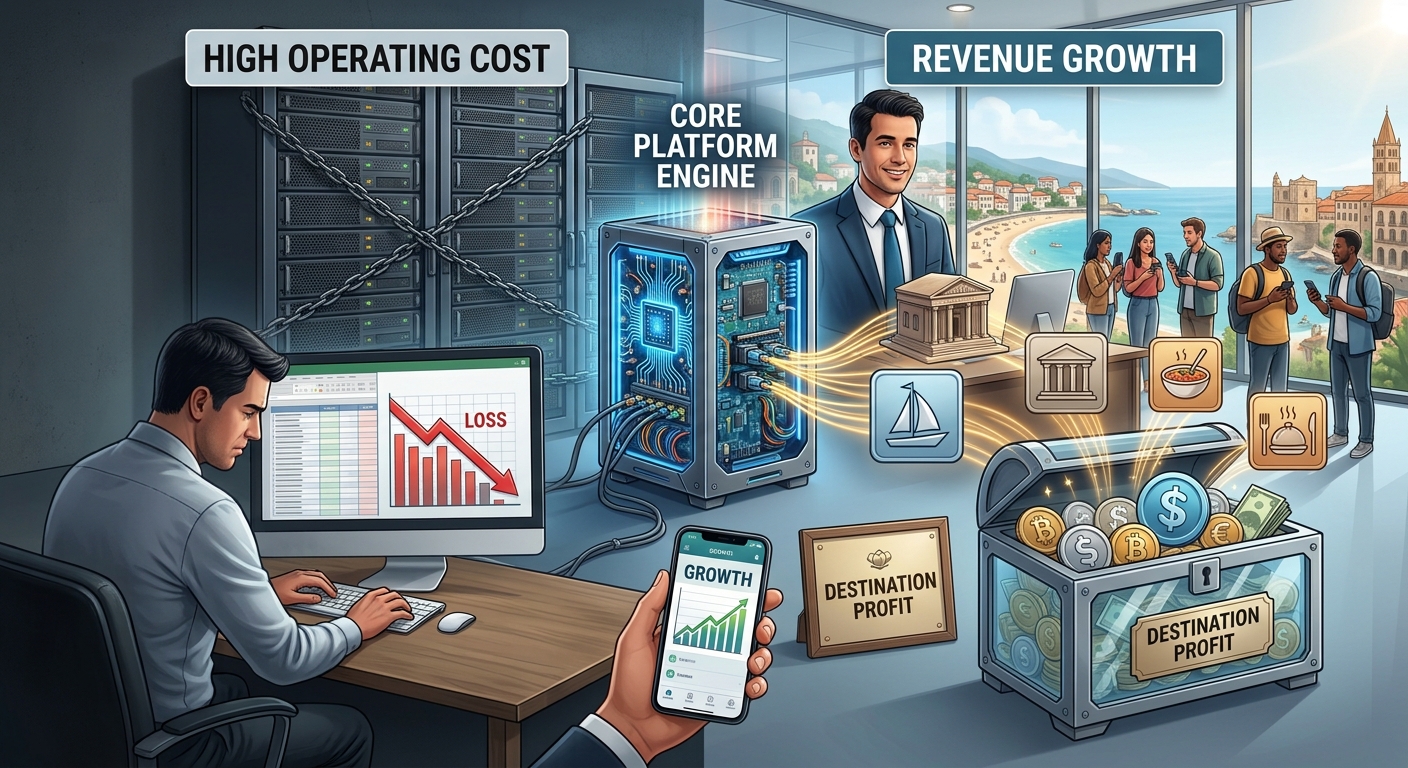
Reservation platforms have spent twenty years creating cost lines for their operators. There is an obvious opportunity to create a revenue one. Consider how a reservation platform appears on an operator’s income statement. It is a cost. A monthly subscription,…

Personalized Travel, Now Inside a Visa Benefit
Personalized Travel, Powered by Tripian’s Nested Artificial Intelligence

The AI Race You’re Fighting Ends at Check-In
The last two years of travel-tech strategy have organized around one question: can we match the market leaders on AI-powered search and booking? For most platforms, the honest answer by mid-2026 is yes, roughly. The chatbots exist. The recommendation engines…