
📅 10 August 2026 | 📂 In-Destination Revenue, Travel Tech Insights

Every travel platform’s 2026 roadmap has a line that reads something like AI-powered personalization or in-destination recommendations. Almost none of them have a line that reads in-destination infrastructure. That is the gap.
Personalization has been treated, structurally, as a feature. Something a product team ships, tests, and iterates on inside the existing booking flow. But the in-destination economy does not run on features. It runs on fragmented, constantly changing, hyper-local inventory: thousands of independent operators, seasonal hours, permit requirements, last-minute closures, pricing that shifts by day and by season.
A feature can recommend an activity. It cannot validate that the activity is still running this week, still bookable, still priced the way the traveler expects. That validation problem is exactly why the revenue leaks out. Not because travelers don’t want in-destination suggestions from a platform they already trust, but because the platform’s data model was never built to keep pace with a destination that changes daily. The gap isn’t between where travelers are booked and where they’d like to spend. It’s between where travelers are booked and where the platform’s own data actually reaches.
This is why bolting a large language model onto an existing booking flow does not close the gap. The model can generate a plausible-sounding itinerary in seconds. It has no reliable way to confirm that the itinerary corresponds to anything real, current, or bookable in that destination today, because nothing underneath it was built to hold that kind of data at that kind of freshness. Ship the feature, and the platform has automated the appearance of personalization without touching the data problem that caused the leak. AI hallucination in travel is a data infrastructure problem, not a model problem: the models are capable, and the data underneath them is not validated or structured.
The platforms positioned to win this cycle are not the ones with the most creative model prompts. They are the ones that treat the in-destination layer the way payments or search infrastructure was treated a decade ago: as a foundational layer every other feature sits on top of, not a bolt-on competing for the same sprint as the next UI refresh.
Concretely, that layer is a small number of things working together. A structured POI graph of more than 4M points of interest across 550+ destinations, continuously validated and carrying multilingual local content. A canonical itinerary data model that a platform builds against, rather than a recommendation feed it merely displays. Commerce rails that handle offer orchestration, voucher issuance, and redemption validation. And format-agnostic ingestion, so a platform’s existing supply and a partner’s inventory land in the same structure instead of in separate silos. Underneath all of it sits governed execution: audit trails, redemption integrity, and a human-in-the-loop review path.
One boundary matters for any technical reader mapping the integration. This layer orchestrates offers and validates redemptions. It is not the Merchant of Record. Payment processing and settlement stay with the platform and its partners, which is also why Visa Global vendor certification sits at the layer rather than being something each platform has to earn again on its own.
This is the layer Tripian has built: API-first infrastructure that sits invisibly inside a platform, connecting fragmented in-destination supply so that whatever personalization or booking experience the platform already ships can trust what it shows a traveler. It is not a consumer app competing for attention. It is the plumbing that keeps a platform’s customer relationship durable past the point of arrival.
For a CTO or CPO weighing the 2026 roadmap, the decision is not whether to fund AI personalization. That funding is already approved somewhere in every competitive set. The decision is what it sits on. Whatever you fund next either sits on infrastructure built to hold a destination’s reality at the freshness a traveler expects, or on a feature that starts eroding trust the first time it recommends something that no longer exists.
Jeff Kischuk
CEO Founder of Tripian
The Channel Manager’s Next P&L Line
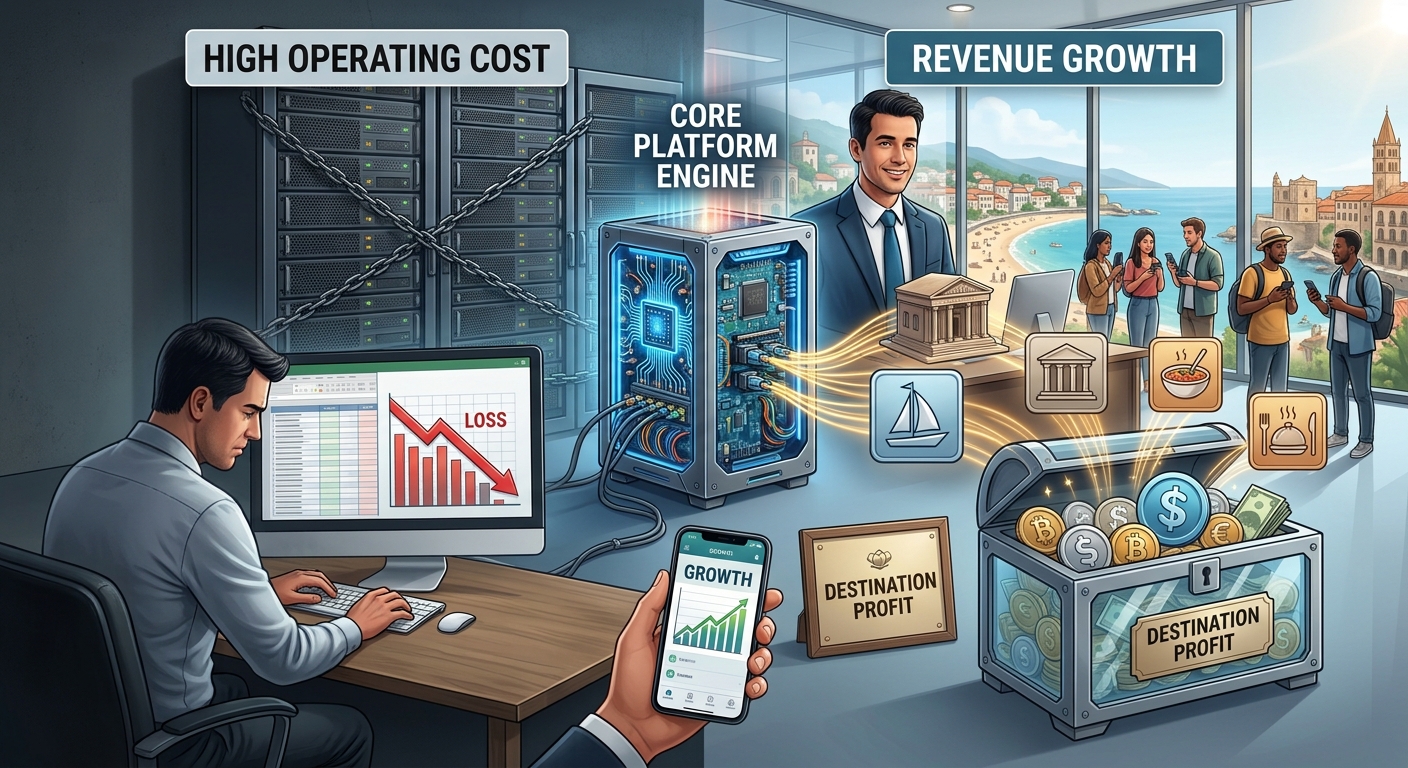
Reservation platforms have spent twenty years creating cost lines for their operators. There is an obvious opportunity to create a revenue one. Consider how a reservation platform appears on an operator’s income statement. It is a cost. A monthly subscription,…

Personalized Travel, Now Inside a Visa Benefit
Personalized Travel, Powered by Tripian’s Nested Artificial Intelligence

The AI Race You’re Fighting Ends at Check-In
The last two years of travel-tech strategy have organized around one question: can we match the market leaders on AI-powered search and booking? For most platforms, the honest answer by mid-2026 is yes, roughly. The chatbots exist. The recommendation engines…