
📅 6 October 2026 | 📂 Destination Management Companies, In-Destination Revenue, Travel Technology
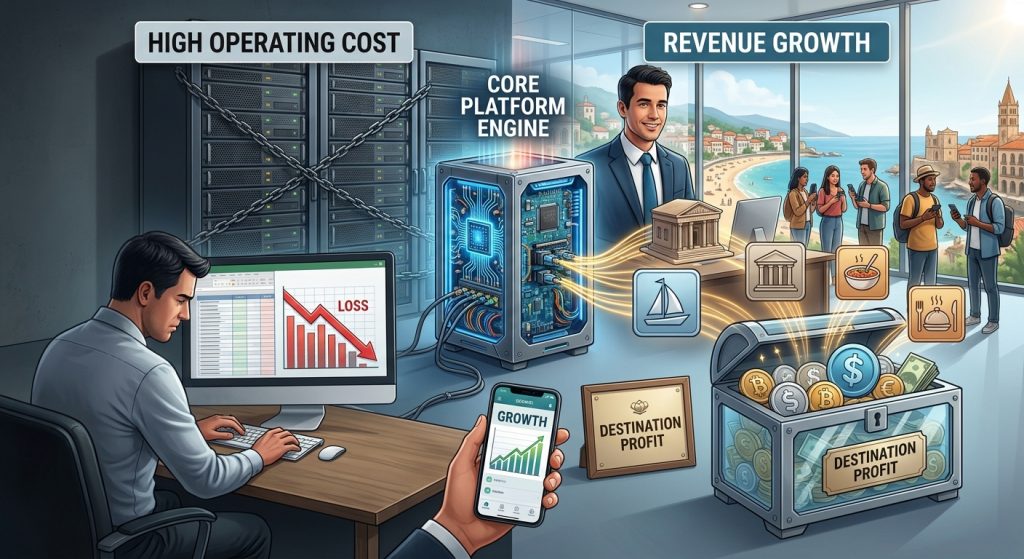
Reservation platforms have spent twenty years creating cost lines for their operators. There is an obvious opportunity to create a revenue one.
Consider how a reservation platform appears on an operator’s income statement.
It is a cost. A monthly subscription, or a per-booking fee, or both. Justified, usually easily, by the channel reach, the admin time saved, the bookings that would not otherwise have arrived. But structurally, it sits with the software and the insurance and the card fees.
Which means every conversation between a platform and its operators about money is a conversation about how much the platform costs. Renewal negotiations are downward pressure. Feature releases are justifications for holding price. Churn conversations are about value for money.
Twenty years of that dynamic, across the entire category, and it is worth asking whether it was inevitable.
The asymmetry hiding in the model
Here is what makes this odd on reflection.
A reservation platform sits at the exact point in the value chain where new revenue could be introduced. It touches the operator’s inventory, the operator’s customer, the booking confirmation, and frequently the pre-arrival communication. It has distribution relationships the operator could never assemble alone.
And it uses all of that to move the operator’s own products more efficiently, which is valuable, and which is also the only thing it does.
Meanwhile the operator’s customer, having booked, goes on to spend a great deal more money in destination. Around 44% of in-destination activity is booked spontaneously, outside whatever platform sold the original trip, in a market estimated near $253B. None of that spend touches the reservation platform, and none of it touches the operator who introduced the customer to the destination in the first place.
So the platform is positioned perfectly to participate in a large adjacent revenue pool, and participates in none of it.
What a revenue line would actually look like
The mechanics are not exotic, which is the argument.
The platform gives its operators a new category to sell. Not the operator’s own products, in-destination experiences, activities and attractions across the destination, contracted by somebody else, available through the platform the operator already uses. The operator recommends and sells; they do not contract, fulfil or carry risk.
Commission, not subscription. In-destination inventory runs around 8 to 16% depending on category and market, on a 70/30 split weighted toward the party generating the sale. The operator earns on something they did not have to build. The platform takes a rate on spend that currently leaves the network entirely.
No new supplier relationships for anyone. This is the part that makes it feasible. Neither the platform nor its operators contract in-destination inventory, that work is a few hundred thousand small operators across sixty-plus countries, in a supply base where roughly 80% still manage bookings through spreadsheets, email and messaging apps. It is consumed as a single integration rather than reproduced.
Why this changes the platform’s own position
Retention. An operator whose platform is a cost line evaluates it annually against alternatives on price and features. An operator whose platform is a source of revenue does not, because switching means switching off an income stream, which is a materially different decision. This is the most durable retention mechanism available to any infrastructure business and almost nobody in this category has it.
Differentiation that cannot be matched by connectivity. Every competitor can add integrations. Reaching parity on connectivity is a matter of engineering effort and time. Reaching parity on contracted in-destination inventory across sixty-plus countries is a multi-year business-development programme, and one that does not compress by being prioritised.
Which means this is the rare platform feature where being first is genuinely defensible rather than merely early.
The conversation this replaces
Right now, every commercial conversation with the operator base is about what the platform costs. There is an available conversation about what the platform pays, and it uses the network that already exists, the operators who are already there, and demand the operators’ own customers are already generating somewhere else.
The category the platform is not selling is the fastest-growing share of traveller spend. The operators are watching their customers buy it from strangers. Turning that into a line item that runs in the operator’s favour is not a new business. It is the platform finally participating in the value it already sits next to.
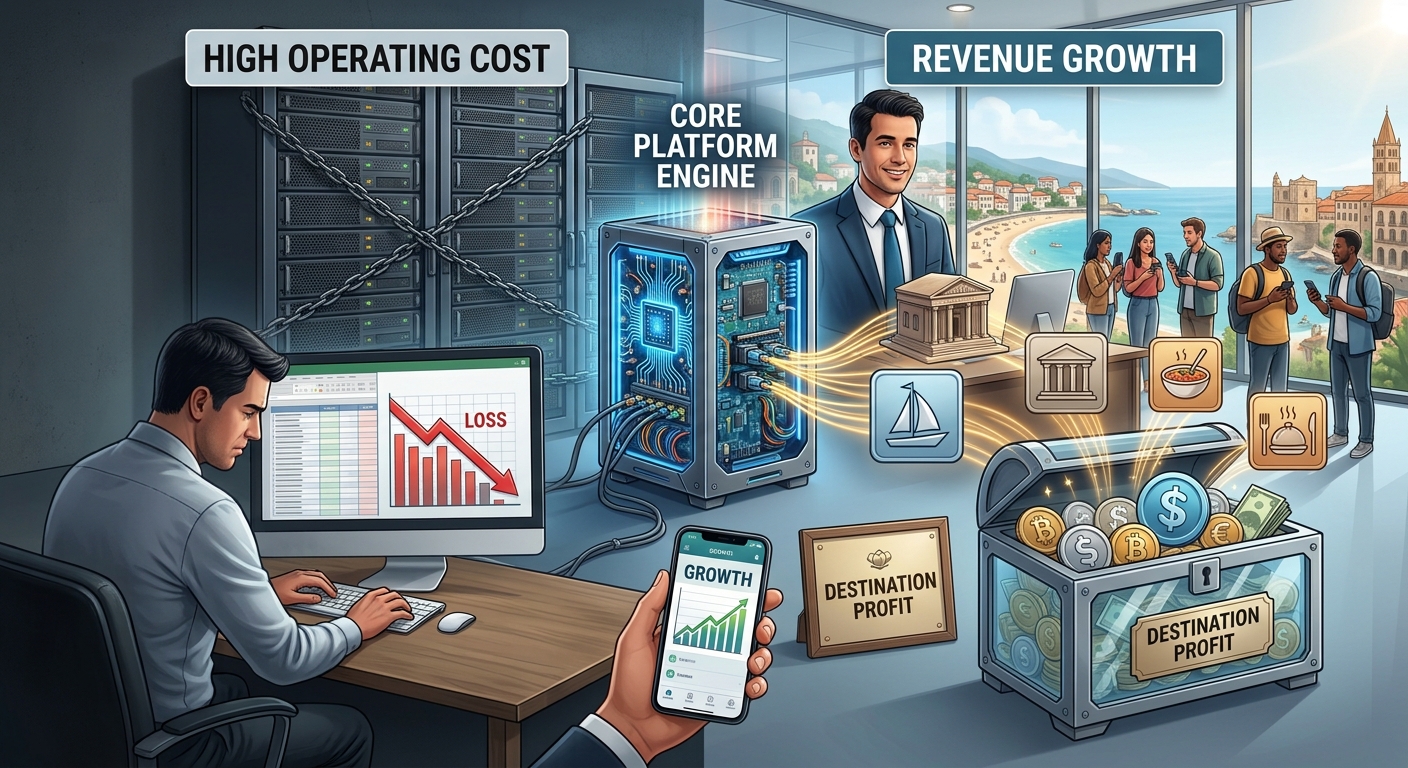
The Channel Manager’s Next P&L Line
Reservation platforms have spent twenty years creating cost lines for their operators. There is an obvious opportunity to create a revenue one. Consider how a reservation platform appears on an operator’s income statement. It is a cost. A monthly subscription,…

Personalized Travel, Now Inside a Visa Benefit
Personalized Travel, Powered by Tripian’s Nested Artificial Intelligence
The AI Race You’re Fighting Ends at Check-In
The last two years of travel-tech strategy have organized around one question: can we match the market leaders on AI-powered search and booking? For most platforms, the honest answer by mid-2026 is yes, roughly. The chatbots exist. The recommendation engines…