
📅 19 March 2026 | 📂 In-Destination Revenue

Forty-four percent of in-destination activities are booked outside the platform that originated the trip. Not because travelers are disloyal. Because the platform gave them no reason to stay.
The Funnel You Built Isn’t Broken — It’s Just Incomplete
The OTA industry has spent two decades engineering one of the most optimized commercial funnels in consumer technology. Search, compare, book. Conversion rates refined to basis points. Retargeting sequences timed to the minute. The moment a traveler clicks “confirm,” that funnel has done its job.
And then it stops.
The traveler lands in-destination and immediately migrates to TripAdvisor for what to do, to Google Maps for where to eat, to a supplier’s own website to book the tour they discovered on Instagram. Every one of those transactions is revenue that the originating platform earned the right to capture and didn’t. Not because of a UX failure. Because the architecture was never designed to follow the traveler past the booking confirmation.
This is the structural gap most commercial leaders haven’t fully priced into their growth models. Ancillary attach rates in the OTA sector hover between 3% and 8%. The addressable ceiling, with the right infrastructure, is closer to 15% to 25%. The delta between those two numbers isn’t a marketing problem. It’s an orchestration problem, a failure to connect the booking layer to the experience layer at the moment it matters most.
Compounding this is the data silo problem. Most OTAs hold rich first-party signals, traveler profiles, loyalty tier, search history, destination intent, but that data sits in a CRM that was never designed to talk to an experience inventory. The personalization engine required to turn a confirmed flight booking into a curated, bookable in-destination itinerary doesn’t exist inside most platforms. It has to be built. And building it, in-house, against the current pace of competitive acceleration, takes 18 to 24 months and a development team you likely don’t have spare.
The $253 billion experience economy is not a future opportunity. It’s a present-tense revenue war. Booking.com and Expedia are both running significant AI personalization initiatives aimed at owning the post-booking relationship. Google’s travel surfaces are increasingly transactional, not just inspirational. The suppliers themselves, tour operators, activity providers, local merchants, are investing in direct-to-consumer digital infrastructure. Every month without a coherent in-destination strategy is not a neutral holding position. It is a market share concession.
This is what makes 2026 an architectural decision year, not a roadmap conversation. Platforms that treat in-destination as a feature will find themselves outflanked by platforms that have wired it into their core commercial infrastructure. The travelers have already shown where they go when platforms fail them.
The question is whether the platforms are ready to follow.
The operators gaining ground on this problem share a common strategic posture: they’ve stopped treating in-destination as a content problem and started treating it as an infrastructure problem. That means connecting supply (300,000-plus bookable experiences across hundreds of destinations) to the demand signals already embedded in their booking flows, and making that entire stack transactable across pre-booking discovery, post-booking cross-sell, and in-destination spontaneous spend.
Tripian’s Nested Artificial Intelligence® platform represents one version of what this looks like in practice; an invisible orchestration layer that integrates with existing booking flows, loyalty programs, and CRM architecture without requiring platform reconstruction. The value proposition is not a chatbot or a recommendations carousel. It is transactional infrastructure: voucher creation, distribution, QR redemption validation, and campaign analytics, operating across the full offer lifecycle at enterprise scale.
The travel platforms that will own the in-destination economy over the next three years aren’t necessarily the ones with the largest booking volumes today. They’re the ones that recognize the booking is the beginning of the commercial relationship, not the end of it. The real question isn’t whether capturing that 44% is worth pursuing. The question is whether your organization will spend 18 to 24 months building the infrastructure to do it, or deploy a proven solution that generates measurable ROI in weeks, before the competitive window narrows further.
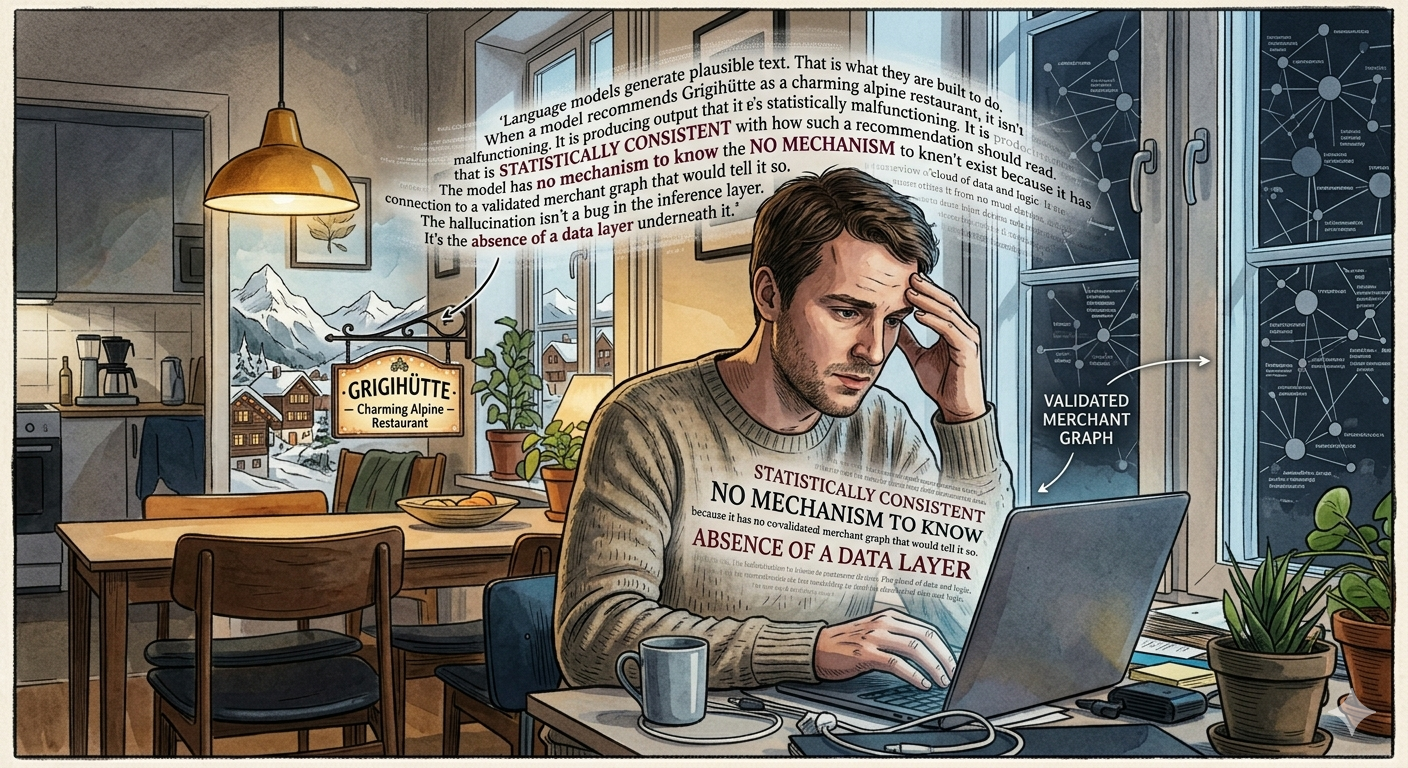
Your Trip Planner Is Lying. Here’s Why.
A credible study just handed your AI roadmap a liability. In testing published by Forbes and InsureMyTrip, AI-powered travel planning tools recommended restaurants, attractions, and experiences that simply do not exist. Not outdated listings. Not temporary closures. Fabrications, complete with…

You Win the Booking. You Lose the Journey.
Forty-four percent of in-destination activities are booked outside the platform that originated the trip. Not because travelers are disloyal. Because the platform gave them no reason to stay. The Funnel You Built Isn’t Broken — It’s Just Incomplete The OTA…

The Platform Era in Travel:
Why Connectivity Determines Competitive Advantage
Enterprise OTAs and DMCs are losing between $8-15M annually to a problem hiding in plain sight: 44% of spontaneous in-destination bookings happen outside their platforms. While your systems capture the initial flight and hotel reservation, travelers are booking experiences through…